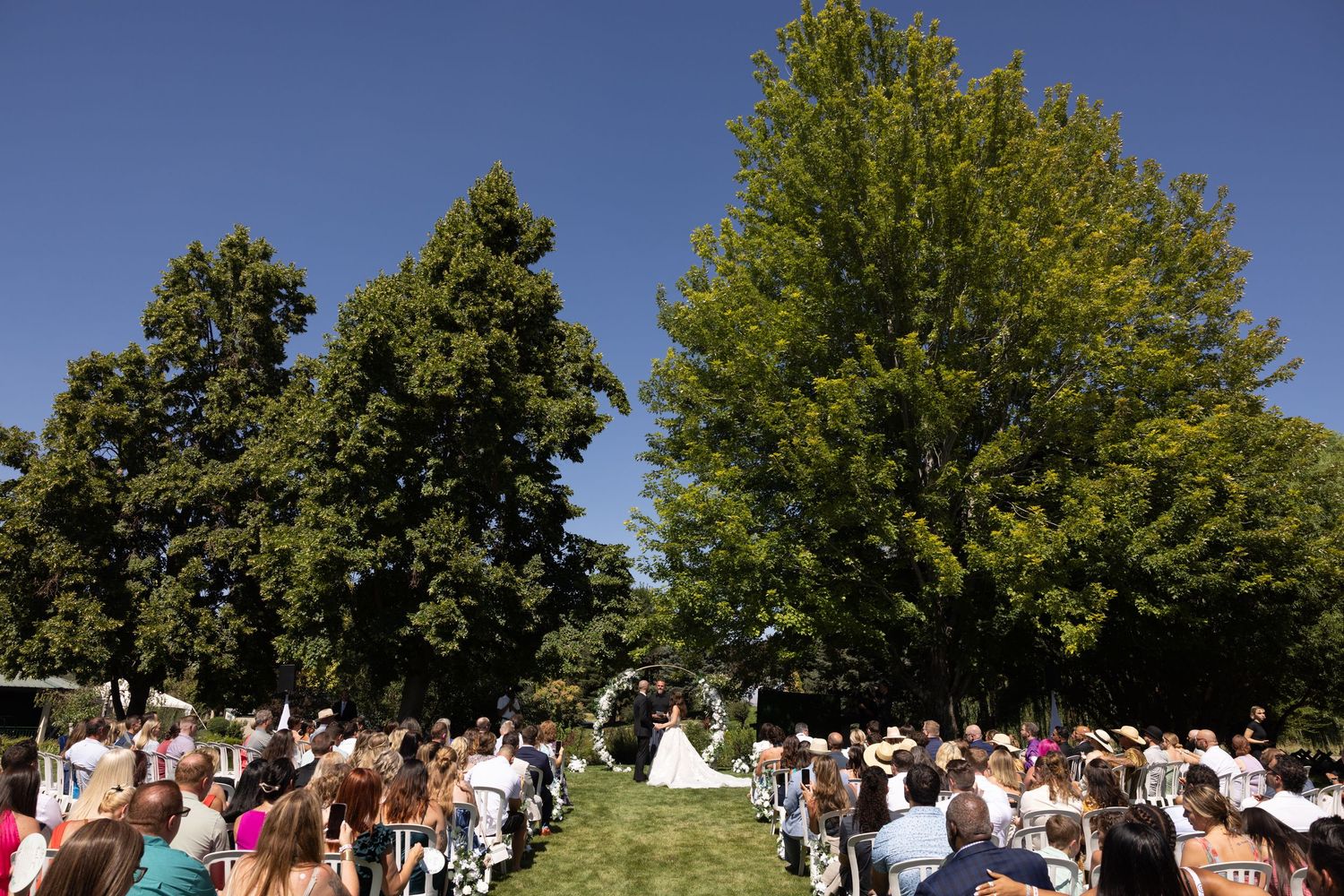
Stephen & Marley | August 2025
Five minutes.
That's what we had left with the couple in a courtyard where the light was doing exactly what you pray light will do. We'd flagged the timeline weeks earlier — fifteen minutes between the ceremony and the reception was never going to be enough, and I'd said so out loud. Oh, it's real fluid. Don't worry, it'll be fine.
It wasn't fine. Things ran behind, none of it ours. We knocked out family portraits, finally got the couple alone, and the planner came over and told us we had a few minutes. Then five. Then she walked into the frame, took the bride's hand, and said, "We're done here."
And the couple deferred to her, and they walked off, and Emily and I looked at each other.
That was one of our last weddings. But the story people usually take from it is the wrong one.
We didn't quit weddings. We priced our way out of needing them.
There's a version of this story where two photographers get fed up and rage-quit an entire market. That's not what happened, and if that's the version you're carrying around, it will keep you stuck.
What actually happened was slower and much less dramatic. We started adding corporate work. In the beginning, ninety-five percent of our revenue was social and weddings and five percent was corporate or other. Then it was ninety-ten. Then eighty-twenty. Then seventy-thirty. We'd go away for one of our little business getaways, put the year on the table, and watch the ratio move.
Somewhere around fifty-fifty, the conversation changed. We stopped asking how to get through wedding season and started asking a much better question: what should weddings look like for us?
That question is only available to you when weddings aren't carrying one hundred percent of your income. That's the whole point of this article, so I'll say it plainly: pricing courage is a downstream effect of revenue diversity. It does not work in the other order.
Collections, packages, and the commodity trap
Here's what we were doing before, and it's probably what you're doing now.
We built collections. (We never called them packages — I can't hear the word without picturing an Amazon driver holding a box.) Three or four tiers, each one a bundle of hours and albums and prints and second shooters, and every year we'd sit down and reconfigure them, convinced that this time we'd get the mix right.
We never got the mix right, because the mix isn't the problem.
Invariably a couple wanted some of what was in the tier and not the rest. And the moment they saw the components, they asked the only logical question: can you just take this out and make it cheaper? Which is a completely fair question. It's also the literal definition of a commodity. Put an item in, price goes up. Take an item out, price goes down. We had built a menu and then acted surprised when people ordered off it.
Emily was the one who reframed it. Artists get commissioned. A painter, a sculptor, a photographer — you don't buy tier two from them. You commission them to make something.
So we stopped selling collections and started quoting a commissioning rate.
"What's included?" "Us."
When we first started doing it, the commissioning rate was $5,000.
The conversation went like this. We never asked a couple what their budget was — we asked how important photography was to them. That question does more work than any sales script I've ever seen, because the answer tells you whether this is a real fit before anybody talks about money.
If the alignment was there, they'd ask how it worked. And we'd say: the investment is $5,000.
Oh — what's included in that?
Us.
Our time, our talent, our knowledge and our experience. Digital files, if they wanted them. Everything past that became a customized proposal built for that specific couple.
That number was the floor. We don't get our cameras out of our bags for less than this amount of money. What you get in exchange is years and years and years of time, talent, experience, knowledge and creativity deployed on your wedding day, to create the moments you'll look back on for generations.
If that sounds familiar, it should. It's how corporate already works. In the corporate world you get a proposal or a brief, and you respond with what the investment would be to cover it. We didn't invent anything. We just stopped running two different businesses with two different philosophies.
The falloff is real, and it's fine
I'm not going to sell you a version of this where nobody says no.
We noticed falloff. Some couples were outside the number, full stop. Others told us flatly that nobody else prices this way — which is true. There are a lot of things we do that other people don't do, and we spent real energy trying to educate couples on why. Some of them couldn't get on board, and they went elsewhere.
Here's the part that surprised us. We were making the same money, and often more, while shooting fewer weddings.
And because the corporate side was running, a no on Tuesday wasn't a crisis. A corporate lead would come in the next day, or we'd make an offer and pick up a run of headshot projects. That's what diversification actually buys you — not just revenue, but the ability to hear "no" without flinching.
What the calendar looks like now
A year ago we photographed a wedding for the first time in about a decade. Corporate clients of ours, Stephen and Marley — people we'd photographed through years of their professional lives, who told us we'd been there since the beginning. We said no twice. They asked a third time, and we said yes, and it was a joy.
It was also a very stark reminder of how hard weddings are. When we got into bed that night we said the same thing at the same time: this is why we don't do it.
But we got to choose. That's the entire thing.
A weekend with a wedding on it. Then a four-day corporate project, Monday through Thursday. Then a weekend off. Then that same corporate client hiring us again in a month or two. Maybe another couple after that, if the fit is right and the number is right.
So the question isn't whether you should do weddings. It's what lies you're telling yourself about your pricing — that it's what everybody else charges, that it's all your market will bear, that raising it would end you. Those aren't facts. They're the ceiling you inherited.
Build the second revenue stream. The courage follows it.
The full playbook for landing corporate clients is at themamones.com/playbook.